2.
City Council Work Session
- Meeting Date:
- 07/20/2026
- TITLE
- Economic and Financial Analysis of Complete Streets in Billings
- PRESENTED BY:
- Elyse Monat
- Department:
- Planning & Community Services
Presentation:
Yes
Legal Review:
No
Project Number:
N/A
RECOMMENDATION
Staff recommends that the City Council receive the presentation on the Economic and Financial Analysis of Complete Streets. At the July 27, 2026, Regular Council Meeting, staff will request the City Council forward a recommendation of study adoption to the Policy Coordinating Committee. This study is informational only and does not contain any infrastructure recommendations.
EXECUTIVE SUMMARY
The Complete Streets Economic and Financial Analysis evaluates the economic and fiscal impacts of Complete Streets investments in four Billings case studies using a difference-in-differences methodology. The study was completed after direction from the Board of County Commissioners, City Council and Planning Board as members of the PCC. Overall, the study found that Complete Streets projects generally increased property values and generated additional property tax revenue that exceeded project costs in most corridors, while also providing evidence of broader transportation and community benefits. The study is informational only and does not recommend future infrastructure projects or policy changes.
BACKGROUND (Consistency with Adopted Plans and Policies, if applicable)
The City of Billings adopted a Complete Streets policy in 2011. In 2016,a checklist was added to the policy. The policy states that “the City of Billings shall consider every Street Project an opportunity to incorporate the principles of Complete Streets,” but it does not prescribe a specific treatment to be applied on every street. The policy does require the Public Works Engineering Division to present all collector and arterial construction and reconstruction projects to the City Council at 30% design, providing an opportunity for the City Council and public to comment on the design. The flexible, context-sensitive Complete Streets policy ensures that the question ‘how are we including all road users on this project?’ is asked rather than requiring a blanket design across the City of Billings.
In recent years, the governing bodies directed the Metropolitan Planning Organization to complete an economic analysis of Complete Streets. Because the decision to undertake this study was made as a mid-year addition to the FFY25 Unified Planning Work Program (UPWP), the MPO had to amend the UPWP to include this project. The Planning Board, City Council, and County Commissioners all forwarded a recommendation of approval of the UPWP amendment, and therefore of conducting the study, to the Policy Coordinating Committee. The amendment of the UPWP authorized the MPO to complete this study. This study is for information only and does not recommend any future infrastructure improvements.
The economic analysis uses a difference-in-differences methodology to assess impacts in four case study corridors, first comparing trends over time (first difference) and then comparing differences between the Complete Streets corridors and control areas (second difference). Staff and consultants carefully considered possible case studies and comparison corridors to enable Cambridge Econometrics (CE) to conduct the study. Even in Billings, a city experiencing rapid growth and known for making significant investments in active transportation networks, the pool of suitable study and comparison corridors was limited once constraints were applied. The City does not build any streets without any Complete Streets elements, such as sidewalks, which are included on all City roadways. Almost all streets also include standard crosswalks at some intersection locations, making a true “control” without any Complete Streets elements impossible to find, and potentially leading to an underestimate of Complete Streets impacts. Another key challenge in assessing economic impacts of Complete Streets in Billings is that these investments often coincide with broader roadway construction or improvements, making it difficult to distinguish the source of the benefits. More recent projects are also completed in growing areas of town, where Complete Streets standards are more universally applied, making it harder to find controls in similarly growing areas of town. At the same time, these examples demonstrate the economic benefits of constructing roads conducive to multiple travel modes.
As mentioned above, selecting case studies and comparison corridors allowed CE to conduct a "difference-in-difference" study. The first difference refers to comparing the selected case study to itself, before and after the Complete Streets facility was implemented. The second difference refers to comparing the case study corridor to a comparison corridor with similar characteristics, but without substantial Complete Streets investment. The study corridors and comparison corridors include:
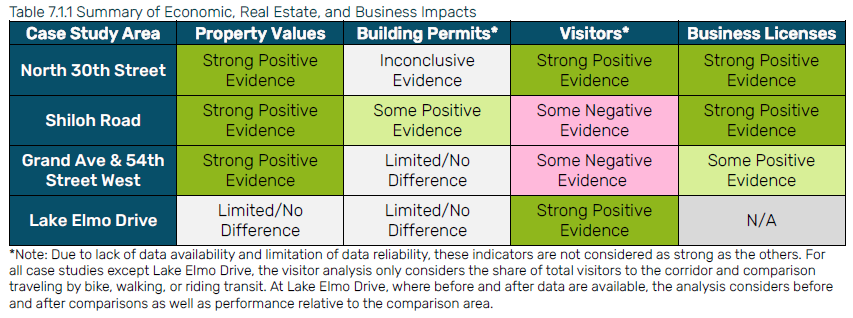
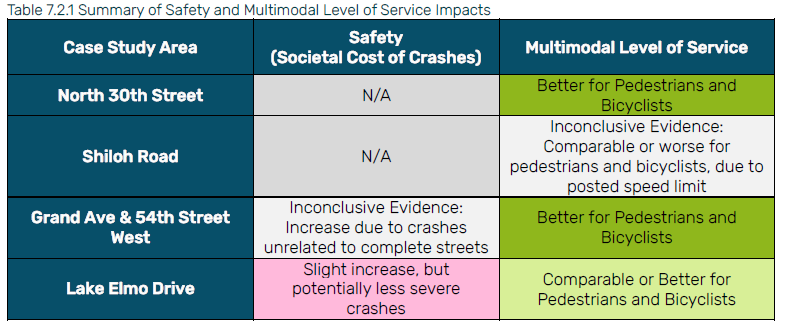
This study includes estimated construction and maintenance costs for the Complete Streets corridors and estimated maintenance costs for the comparison corridors. A difference-in-difference analysis was conducted (where data were available) on property values, the value/number of building permits,corridor visitation,and the growth in business licenses. Additionally, the study considered if the Complete Streets facilities improved the level of service or reduced the level of traffic stress for people on foot or by bike. For two of the corridors, safety data was available to compare crashes before and after Complete Streets elements were constructed. The following tables summarize the high level findings of the study.
The study also included a high-level assessment comparing costs to economic and fiscal benefits. First, additional costs associated with maintaining the Complete Streets corridors were calculated. The added maintenance costs, plus the Complete Streets construction costs for the facilities, were compared against the property value impacts from each project. Property value impacts were calculated using a difference-in-differences analysis of the total (aggregate) property values along the corridor. In this analysis, the actual property values at the study areas were compared to an estimated counterfactural growth rate to show what would have happened if construction did not take place. The estimated tax revenue impacts based on the higher property values in the study corridor were also estimated and are shown in Table 4.1.2.
As with other estimates in this report, these values are estimated based on several key assumptions and have associated limitations. However, taken all together, the high-level effects of tax impacts can be drawn. In this case, it is clear that the case study areas outperformed the comparison areas in terms of property values, which has led to substantial increases in property tax revenues each year.
Lastly, property tax benefits are compared to the total costs of the Complete Streets projects. As shown in the table, property tax gains far exceed project costs in all cases except Lake Elmo Drive, generating millions in net new revenue. Overall, these results provide supporting evidence that the property tax benefits of Complete Streets outweigh the associated costs,even without considering benefits to business performance and other safety and community impacts.
In recent years, the governing bodies directed the Metropolitan Planning Organization to complete an economic analysis of Complete Streets. Because the decision to undertake this study was made as a mid-year addition to the FFY25 Unified Planning Work Program (UPWP), the MPO had to amend the UPWP to include this project. The Planning Board, City Council, and County Commissioners all forwarded a recommendation of approval of the UPWP amendment, and therefore of conducting the study, to the Policy Coordinating Committee. The amendment of the UPWP authorized the MPO to complete this study. This study is for information only and does not recommend any future infrastructure improvements.
The economic analysis uses a difference-in-differences methodology to assess impacts in four case study corridors, first comparing trends over time (first difference) and then comparing differences between the Complete Streets corridors and control areas (second difference). Staff and consultants carefully considered possible case studies and comparison corridors to enable Cambridge Econometrics (CE) to conduct the study. Even in Billings, a city experiencing rapid growth and known for making significant investments in active transportation networks, the pool of suitable study and comparison corridors was limited once constraints were applied. The City does not build any streets without any Complete Streets elements, such as sidewalks, which are included on all City roadways. Almost all streets also include standard crosswalks at some intersection locations, making a true “control” without any Complete Streets elements impossible to find, and potentially leading to an underestimate of Complete Streets impacts. Another key challenge in assessing economic impacts of Complete Streets in Billings is that these investments often coincide with broader roadway construction or improvements, making it difficult to distinguish the source of the benefits. More recent projects are also completed in growing areas of town, where Complete Streets standards are more universally applied, making it harder to find controls in similarly growing areas of town. At the same time, these examples demonstrate the economic benefits of constructing roads conducive to multiple travel modes.
As mentioned above, selecting case studies and comparison corridors allowed CE to conduct a "difference-in-difference" study. The first difference refers to comparing the selected case study to itself, before and after the Complete Streets facility was implemented. The second difference refers to comparing the case study corridor to a comparison corridor with similar characteristics, but without substantial Complete Streets investment. The study corridors and comparison corridors include:
- N. 30th St. from Grandview Blvd. to Montana Ave.
- Comparison corridor: N. 32nd St. from Parkhill Dr. to Montana Ave.
- Shiloh Rd. from Broadwater Ave. to Hesper Dr.
- Comparison corridor: 24th St. W. from Central Ave. to King Ave.
- Grand Ave. from 52nd St. W. to Wilderness Dr. and 54th St. W. from Grand Ave. to Rimrock Rd.
- Comparison corridor: 24th St. W. from Central Ave. to King Ave.
- Lake Elmo Dr. from Wicks Ln. to Robertson Rd.
- Comparison corridor: Babcock Blvd. from Governors Blvd. to Wicks Ln.
This study includes estimated construction and maintenance costs for the Complete Streets corridors and estimated maintenance costs for the comparison corridors. A difference-in-difference analysis was conducted (where data were available) on property values, the value/number of building permits,corridor visitation,and the growth in business licenses. Additionally, the study considered if the Complete Streets facilities improved the level of service or reduced the level of traffic stress for people on foot or by bike. For two of the corridors, safety data was available to compare crashes before and after Complete Streets elements were constructed. The following tables summarize the high level findings of the study.
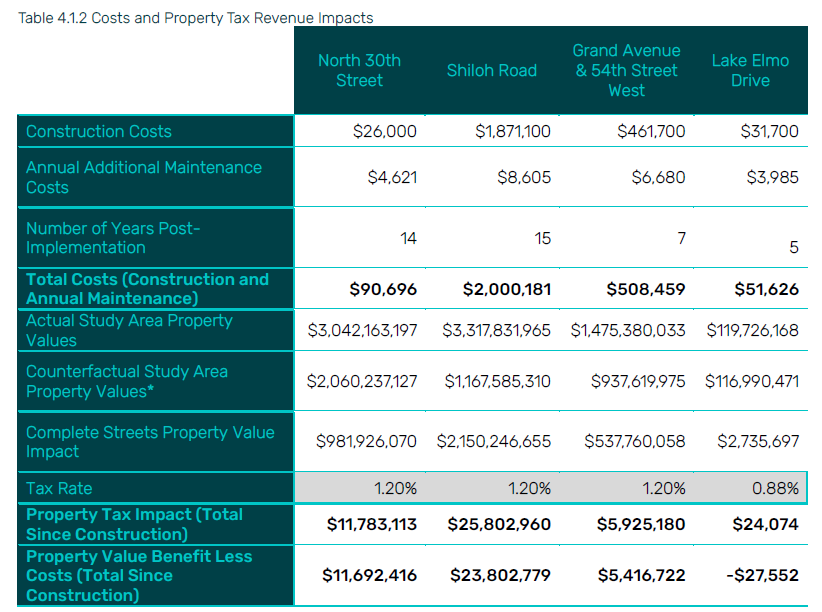
The study also included a high-level assessment comparing costs to economic and fiscal benefits. First, additional costs associated with maintaining the Complete Streets corridors were calculated. The added maintenance costs, plus the Complete Streets construction costs for the facilities, were compared against the property value impacts from each project. Property value impacts were calculated using a difference-in-differences analysis of the total (aggregate) property values along the corridor. In this analysis, the actual property values at the study areas were compared to an estimated counterfactural growth rate to show what would have happened if construction did not take place. The estimated tax revenue impacts based on the higher property values in the study corridor were also estimated and are shown in Table 4.1.2.
As with other estimates in this report, these values are estimated based on several key assumptions and have associated limitations. However, taken all together, the high-level effects of tax impacts can be drawn. In this case, it is clear that the case study areas outperformed the comparison areas in terms of property values, which has led to substantial increases in property tax revenues each year.
Lastly, property tax benefits are compared to the total costs of the Complete Streets projects. As shown in the table, property tax gains far exceed project costs in all cases except Lake Elmo Drive, generating millions in net new revenue. Overall, these results provide supporting evidence that the property tax benefits of Complete Streets outweigh the associated costs,even without considering benefits to business performance and other safety and community impacts.
FISCAL EFFECTS
This study is informational only, and there are no fiscal effects to adopting the study.
STAKEHOLDERS
The entire community is a stakeholder as street design affects residents' daily lives. Complete Streets facilities can provide additional options for residents to reach jobs, education, healthcare, and other daily needs.
For the study, several stakeholders were interviewed to get input on how Complete Streets affect the community. Stakeholders interviewed included those from the Downtown Billings Association, Living Independently for Today and Tomorrow (LIFTT), Big Sky Economic Development, the Billings Chamber of Commerce, the developer of Shiloh Commons, and Intermountain Health.
For the study, several stakeholders were interviewed to get input on how Complete Streets affect the community. Stakeholders interviewed included those from the Downtown Billings Association, Living Independently for Today and Tomorrow (LIFTT), Big Sky Economic Development, the Billings Chamber of Commerce, the developer of Shiloh Commons, and Intermountain Health.
ALTERNATIVES
This is a presentation only. At the Council's regular meeting on July 27, 2026, staff will request that the Council send a recommendation to adopt the study to the Policy Coordinating Committee.